



armadillo
Armadillo is a mammal of the family Armadillidae in the order Heterodontoides. The armadillo is named after the nine layered ribbon on its body. Armadillos are distributed in the southern tip of South America, along the Caribbean coast, and on the Central American continent. Armadillos are burrowing animals that live underground, hiding during the day and coming out at night. They have poor vision but excellent sense of smell and can accurately locate ant nests. Scientists have extracted leprosy bacteriocins from it to produce leprosy vaccines, which has played a great role in promoting human control of leprosy. Moreover, armadillos are easy to domesticate and are one of the precious animals in modern medical experiments.
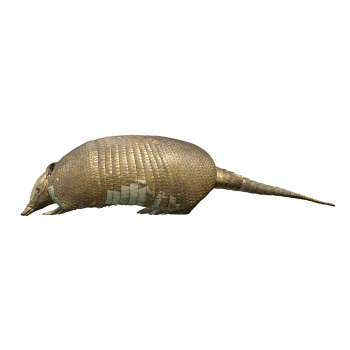
Armadillo specimen
Armadillo is a mammal of the family Armadillidae in the order Heterodontoides. The bone armor covers the head, body, tail, and outer legs. The bone armor in the head, front half, and back half is separated, and the bone armor in the body forms a band shape, allowing for flexible movement; Having sparse hair in areas of the body without bone armor; There are strong claws on the front foot. The armadillo is named after the nine layered ribbon on its body. A armadillo can eat 100 kilograms of poisonous spiders, scorpions, ants, beetles and other insects in a year, which plays a positive role in pest control to a certain extent.

Popular Models


Honey Badger (3D animated model)
196 View

Guinea fowl (3D animated model)
165 View

Wild Goose (3D animated model)
187 View

Red Fox (3D animated model)
155 View
Random Model

Maserati 2009 Quattroporte S
708 View

French style table and chair set
409 View

Lion Cub 3D Model Animation
802 View


Green Turtle 3D Model Animation
949 View

Harley-Davidson FXDLS Dyna 2016
841 View




armchair
626 View